


20 Set Art, Architecture and Landscape in Southern Lazio
Two Lands, Two Artistic Souls
Neighbouring lands, contiguous and yet, in many ways, worlds apart. Southern Lazio is shaped by two territories whose histories seem to move in opposite directions. On one side lies Ciociaria, a land inhabited since ancient times, where hilltop settlements, stone villages and cyclopean walls preserve the memory of peoples and communities that have occupied these landscapes for millennia. On the other lies the Agro Pontino, a much younger territory, reclaimed from water and marshland after centuries of attempts to transform a difficult and often hostile environment.
One is a landscape of rock, elevation and memory. The other is a landscape of water, horizontality and transformation. The distinction is not merely geographical. It can also be read through the art, architecture and literature produced in and inspired by these two territories.
Ciociaria, apparently anchored to its ancient stone, became the birthplace of artists who experimented with movement, abstraction, photography and new artistic languages. The Agro Pontino, radically transformed during the twentieth century, became instead a vast stage for modern urban planning, Rationalist architecture and artistic representations of labour, land reclamation and the construction of a new landscape. From the rugged hills of Ciociaria to the geometric plain stretching towards the Tyrrhenian Sea, Southern Lazio can therefore be explored as a single cultural journey — one built around a fascinating dialogue between ancient and modern, permanence and transformation, rock and water
Ciociaria: Stone, Memory and the Avant-Garde
At first sight, Ciociaria seems a territory defined above all by continuity. Its towns cling to hills and rocky ridges. Ancient walls, medieval streets, churches, stone houses and cultivated slopes give physical form to a landscape shaped over an extraordinarily long period of time.
Yet during the twentieth century, this deeply rooted territory demonstrated a remarkable capacity to generate experimentation. Rather than producing an art dominated by nostalgia, Ciociaria became associated with artists who questioned traditional form and searched for radically new ways of representing movement, matter and modernity. The solidity of the landscape seems almost to provide the counterpoint to the dynamism of the art that emerged from it.
Umberto Mastroianni: From Stone to Metal
Born in Fontana Liri, Umberto Mastroianni became one of the major Italian abstract sculptors of the twentieth century. Bronze and steel replaced the stone of his native landscape, but the sense of strength remained. His sculptures fragment geometric forms and propel them into space, transforming solid matter into movement and energy. Perhaps nowhere is this relationship between art, history and territory more powerful than in Cassino. Near Rocca Janula stands Mastroianni’s Monumento alla Pace, also known as La Grande Esplosione: an imposing structure conceived in memory of the destruction suffered by Cassino and its Abbey during the Second World War.
Here sculpture does not sit quietly within the landscape. It erupts from it. The work transforms the violence of explosion into an abstract monument and creates a dialogue between twentieth-century history and the ancient landscape surrounding the city.
Ernesto Biondi: Monument, People and Territory
A very different relationship with matter appears in the work of Ernesto Biondi, born in Morolo in the nineteenth century. Where Mastroianni fragmented form, Biondi remained profoundly figurative. His bronze and marble works are populated by bodies, gestures and collective scenes, reaching their most celebrated expression in works such as Saturnalia. His presence can still be traced across the territory. Morolo preserves his memory through the Museo Comunale Ernesto Biondi; Frosinone through the monument dedicated to Nicola Ricciotti and the Martyrs of Liberty in Frosinone; Gorga through the Fontana della Pastorella. But Biondi also creates an unexpected geographical bridge between the two landscapes explored in this journey.
At Cisterna di Latina, his Fontana della Bella Ninfa celebrates the arrival of public water. In a territory historically marked by marshland and malaria, water becomes not simply an element of nature but a symbol of human transformation. Through Biondi, our journey begins almost imperceptibly to move from the rocks of Ciociaria towards the waters of the Pontine Plain.
The Bragaglia Brothers: Capturing Movement
Ciociaria’s encounter with modernity did not occur only through sculpture.
Born in Frosinone at the end of the nineteenth century, Anton Giulio, Arturo and Alberto Bragaglia explored the possibilities offered by photography, cinema and stage design.
Their experiments in Futurist Photodynamism rejected the idea of photography as a simple reproduction of reality. Through exposure and light, movement itself became the subject. The human figure was no longer frozen in an instant but dissolved across space, leaving behind traces of its movement. Images such as Lo schiaffo and La dattilografa belong to a radically different visual world from the stone villages surrounding Frosinone. Yet that contrast is precisely what makes Ciociaria’s twentieth-century artistic history so fascinating. A landscape associated with permanence produced artists obsessed with movement.
Between Two Worlds: Libero de Libero
Before descending towards the Pontine Plain, one figure offers an almost perfect bridge between the two territories. Poet and cultural organiser Libero de Libero was born in Fondi, a place positioned geographically and culturally between the inland landscape and the coastal plain.
His artistic material was neither steel nor photography, but language. In his poetry, the landscape of Southern Lazio becomes elemental: twisted olive trees, scorched stone, brigands, legends and memories inhabit a world in which the local becomes almost mythological. De Libero’s importance lies precisely in this transformation. Landscape is no longer merely scenery. It becomes memory, identity and literary material. Through his words, the physical geography of Southern Lazio acquires an interior dimension — a territory carried within those who belong to it.
The Agro Pontino: From Water to Modernity
Leaving behind the rugged cliffs and perched settlements of the inland territory, the horizon changes dramatically. The landscape opens. Mountains give way to a vast plain. Verticality becomes horizontality. Ancient paths are replaced by straight roads and canals. This is the Agro Pontino. Its modern identity cannot be separated from the long struggle to reclaim the marshes. Attempts at drainage date back centuries, but the radical transformation of the territory during the twentieth century produced something exceptional: not simply reclaimed agricultural land, but an entirely new cultural and architectural landscape. Here, unlike in Ciociaria, modernity did not have to negotiate continuously with an ancient urban fabric. It could draw directly onto the territory. The plain became, quite literally, a canvas.
Duilio Cambellotti: The Artist of the Marsh
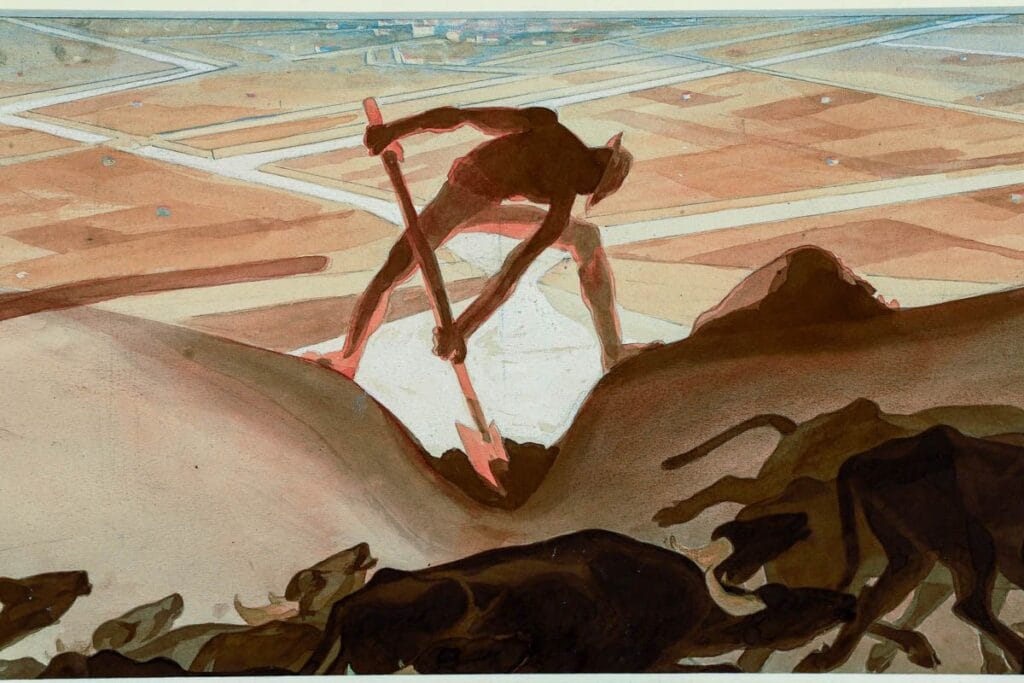
Few artists are as closely associated with the visual identity of the Agro Pontino as Duilio Cambellotti. Although born in Rome, Cambellotti encountered the Pontine Marshes before their definitive reclamation and was deeply affected by the harsh lives of the people and animals inhabiting them. Peasants, settlers, horses and buffaloes became recurring protagonists of his artistic language. Cambellotti was a remarkably versatile artist — sculptor, painter, engraver, designer and set designer — and his representation of the marshes combines the directness of Realism with the linear force of Art Nouveau. What interested him was not simply the physical transformation of the territory. It was the human struggle embedded within it.
In Latina, his presence remains particularly strong. The Cambellotti Museum preserves sculptures, ceramics, woodcuts, furniture and preparatory works, while the Palazzo del Governo contains monumental works connected to the transformation of the Pontine landscape. Through Cambellotti, reclamation becomes more than an engineering project. It becomes an epic of people, animals, labour and land.
Sabaudia: When the City Meets the Landscape
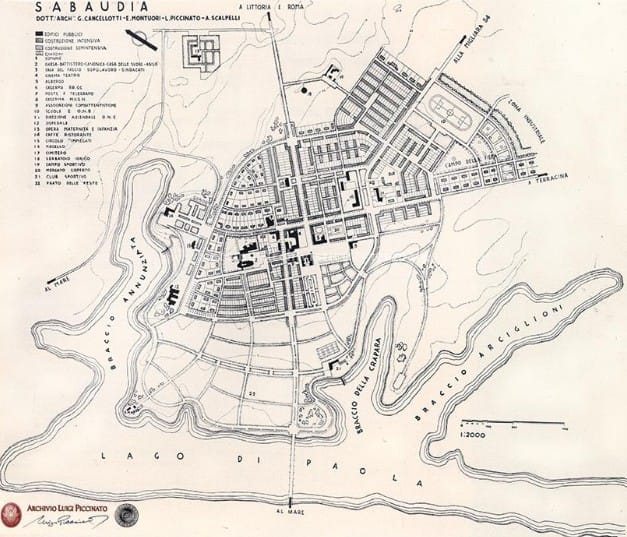
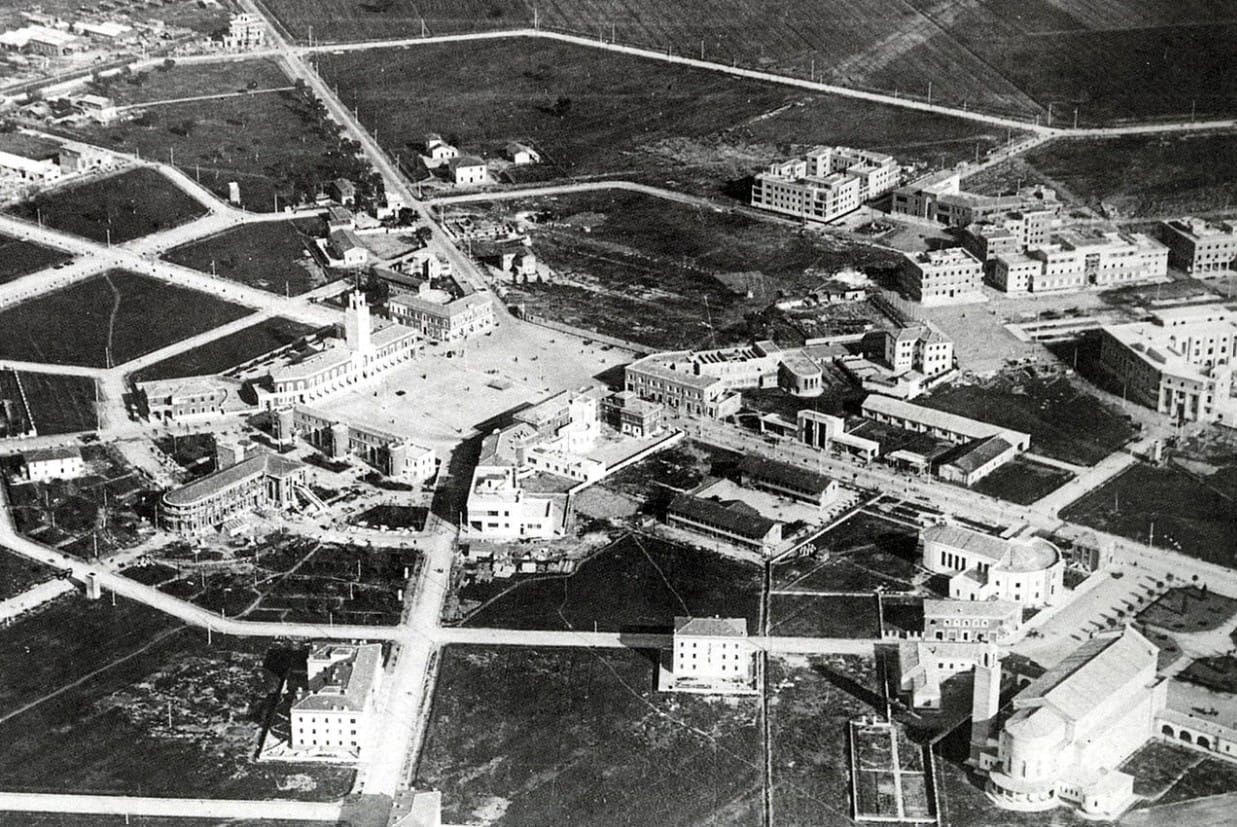
If Cambellotti represents the human and almost primordial dimension of the Pontine Marshes, Sabaudia represents another extraordinary aspect of their transformation: the possibility of creating a modern city almost from the ground up. The new towns of the Agro Pontino turned the plain into one of the most distinctive experiments in twentieth-century Italian urbanism. Sabaudia is perhaps the clearest expression of this relationship between architecture and landscape. Designed by a group of architects and planners including Luigi Piccinato and Eugenio Montuori, the city combines the geometric clarity of Rationalist architecture with its extraordinary natural setting. The relationship is not simply decorative.
Urban spaces and architectural volumes were conceived in dialogue with the lake and the landscape of what is now the Circeo National Park. Openings within the urban composition allow architecture and nature to remain visually connected.
The result is a place where modernity does not simply occupy the landscape: it frames it.
Rationalist Architecture: Building a New Landscape
Latina and Sabaudia demonstrate two different expressions of the architectural transformation of the plain. Oriolo Frezzotti played a central role in the planning and monumental architecture of Latina, then Littoria, while Piccinato and his collaborators shaped Sabaudia. Alongside them, engineer and architect Angiolo Mazzoni brought another experimental language to the territory.
His post offices in Latina and Sabaudia transformed buildings associated with everyday public services into striking pieces of modern architecture. Aerodynamic forms, ribbon windows and unusual materials and colours expressed an architecture fascinated by movement and technological modernity. What makes the Rationalist heritage of the Agro Pontino particularly compelling today, however, is not simply the individual buildings. It is the scale of the experiment. Roads, canals, farms, public buildings and entirely new towns became elements of a newly constructed landscape. Architecture and territory became inseparable.
Emilio Greco: The Human Figure within the Geometric City
Sabaudia also provides the setting for another, subtler dialogue between art and architecture. The sculptor Emilio Greco, Sicilian by birth, developed a profound connection with the city and eventually chose to be buried there. His sculptures introduce softness into the Rationalist landscape. The sinuous human figures for which Greco became internationally known appear almost in deliberate contrast with Sabaudia’s straight lines, square volumes and monumental spaces. Today the Museo Emilio Greco, housed within the Rationalist Palazzo Comunale, brings these two visual languages together. The collection contains sculptures, drawings, medals and graphic works, including monumental plaster casts connected with Greco’s celebrated doors for Orvieto Cathedral. Here, the encounter between artwork and setting becomes part of the experience itself: the curve of the human body against the geometry of the modern city.
Landscape as Literature: Antonio Pennacchi
The transformation of the Agro Pontino did not end with canals, farms and architecture. It also created stories. In the work of Antonio Pennacchi, born in Latina into a family of settlers from northern Italy, the reclamation of the marshes becomes a human and literary epic. His novel Canale Mussolini brings together families, migration, labour, political history and the physical transformation of the land. The landscape itself becomes a protagonist. This is why travelling through the Agro Pontino can sometimes feel like travelling through the pages of his work. The straight drainage canals, agricultural holdings and traces of the reclamation system still visible across the countryside are not simply remnants of infrastructure. They form an agrarian and anthropological landscape, shaped by the people who arrived, worked and built new lives there.
Architecture as a Way of Reading Southern Lazio
Taken separately, Ciociaria and the Agro Pontino could appear to belong to entirely different histories. One looks backwards across millennia; the other bears the unmistakable imprint of twentieth-century transformation. Yet travelling between them reveals something more complex. Both landscapes demonstrate how communities shape the places they inhabit — and how places, in turn, shape culture.
In Ciociaria, settlement adapted itself to topography. Towns rose on defensible ridges and rocky heights. Stone became wall, house, street and monument.
In the Agro Pontino, the process was almost reversed. The landscape itself was first transformed through canals, roads and agricultural organisation, allowing new settlements and new architecture to emerge.
One is largely a history of adaptation to the land. The other is a history of transformation of the land. And yet both produced distinctive relationships between architecture, art and place. This is precisely what makes Southern Lazio so compelling to explore today. Its identity cannot be reduced to a single architectural style, historical period or image of the Italian landscape. Within a relatively short distance, the traveller can move from ancient stone settlements to twentieth-century planned cities; from narrow medieval streets to vast geometric plains; from cyclopean walls to Rationalist architecture. Understanding these differences means learning to read the territory — not as a collection of isolated monuments, but as a landscape shaped by centuries of human choices.
Rock and Water, Ancient and Modern
Rock and water. Memory and foundation. Ancient and modern. The two souls of Southern Lazio continue to converse through their landscapes and through the artists, architects and writers who interpreted them. Ciociaria, seemingly anchored to the permanence of stone, produced some of the most dynamic experiments of Italian modernity. The Agro Pontino, born from a landscape of water and mud, became the setting for an extraordinary experiment in geometry, architecture and the construction of a new territory. Their histories began far apart. Today they form parts of a single journey. A journey from the cyclopean walls and cliffside villages of Ciociaria to the canals, modern cities and open horizons of the Pontine Plain — revealing a Southern Lazio where landscape is never merely a backdrop. It is architecture, memory, art and story.

The Anatomy of Renovation Costs: What Does It Really Cost to Restore a Country House in Southern Lazio?
Read More »THINKING OF BUYING OR RENOVATING A HOME IN ITALY?
Get practical insights on property checks, renovation costs, local regulations and life in Southern Lazio — delivered to your inbox.
No spam. Just useful advice and inspiration. Unsubscribe anytime.