



21 Set How Easy Is It to Buy a Property in Italy?
Buying a property in Italy is often easier than international buyers expect.
Foreign buyers purchase homes in Italy every year, from apartments in historic towns to country houses, farmhouses and properties requiring complete restoration. The legal process is well established and, with the right professional support, the purchase itself can be relatively straightforward.
But there is an important distinction to make.
Buying a property in Italy may be straightforward. Understanding exactly what you are buying can be more complicated.
This becomes particularly important when looking at older houses, historic buildings and rural properties, where planning history, building compliance, structural condition and renovation potential can matter just as much as the asking price.
So how difficult is it really?
Can foreigners buy property in Italy?
In many cases, yes.
EU citizens can generally purchase property in Italy without restrictions. For non-EU citizens, the situation can depend on nationality, residency status and Italy’s reciprocity rules, so this is something that should be checked at the beginning of the process with a notary or other appropriately qualified professional.
Buying a house in Italy also does not automatically give a foreign buyer the right to live permanently in the country. Property ownership and immigration/residency rights are separate matters.
Once eligibility has been established, however, the purchasing process itself follows a fairly defined route.
What do you need to buy a house in Italy?
One of the first things an international buyer normally needs is an Italian codice fiscale, or tax identification number.
You will need it for many aspects of the purchase and for practical matters connected with owning a home in Italy.
Depending on the transaction and your circumstances, you may also need to organise how funds will be transferred and how ongoing expenses will be paid. An Italian bank account can sometimes make certain practical matters easier, but whether one is necessary will depend on the individual situation.
The more important step is assembling the right professional team.
In Italy, several professionals may be involved in a property purchase, and their roles are not interchangeable.
The estate agent, notary, lawyer and architect do different jobs
This is one of the areas international buyers sometimes find confusing.
A real estate agent facilitates the property transaction and acts as an intermediary between the parties.
A notary (notaio) is a public official with a central legal role in the transfer of ownership. The notary carries out the legal checks required for the deed and formalises the sale.
Some international buyers also choose to appoint an independent lawyer, particularly when the transaction is complex or they want additional legal representation.
But there is another question that deserves attention:
Who is evaluating the building itself?
A property can be legally purchasable and still present significant architectural, technical or planning issues for the buyer.
This is particularly relevant if you intend to renovate it.
Finding a house is often the easy part
Property portals make it possible to browse hundreds of Italian houses from anywhere in the world.
Beautiful stone farmhouse. Olive trees. Views over the valley. Original terracotta floors. Thick stone walls.
It can look perfect in photographs.
But photographs cannot tell you everything you need to know.
Before committing to an older property, it is worth understanding questions such as:
- What is the actual condition of the building?
- Does the existing layout correspond with the authorised documentation?
- Are there later additions or alterations?
- Are there planning or landscape restrictions?
- What can realistically be changed?
- Does the roof require work?
- Are there signs of moisture or structural problems?
- How difficult is access for construction work?
- Are utilities already connected?
- What might a realistic renovation involve?
None of these questions necessarily means that you shouldn’t buy the property.
They simply help you understand what you are actually buying.
Older Italian houses need a different approach
This is particularly important in areas such as Southern Lazio, where the housing stock can include medieval village houses, stone farmhouses, rural buildings and properties altered many times over generations.
An old house should not necessarily be judged according to the same criteria as a modern apartment.
Uneven walls, old timber structures or traditional materials are not automatically defects. In many cases, they are precisely what gives the building its character.
The real question is whether the building is sound, whether its history is properly documented and whether it can be adapted to the way you want to live.
This is why an architectural assessment before buying can be so valuable.
It changes the question from:
“Do I love this house?”
to:
“Do I understand this house, and can it become the home I want?”
What happens before the final purchase?
The exact sequence can vary according to the transaction, but a typical purchase may involve an offer, preliminary contractual arrangements and eventually the final deed of sale, the rogito.
One important point for foreign buyers is not to treat the early stages casually.
An offer or preliminary agreement can have significant legal and financial consequences.
Before making binding commitments, you should therefore understand the conditions of the offer, the documentation available for the property and what checks still need to be completed.
This is one reason why having independent professional advice early in the process can be much more useful than discovering a problem shortly before completion.
What about buying a house that needs renovation?
This is where the process becomes more interesting — and potentially more complicated.
The asking price is only one part of the financial picture.
Imagine finding a rural house for €150,000 and planning to spend another €100,000 on restoration.
Before buying, you need to know whether that €100,000 is remotely realistic.
The answer depends on much more than the number of square metres.
The condition of the roof and structure, accessibility, windows, heating and electrical systems, drainage, finishes, professional fees, permissions and the quality of restoration you want can all affect the final cost.
There may also be elements worth preserving rather than replacing: original doors, stonework, timber beams, terracotta floors and traditional plaster can become some of the most valuable characteristics of the finished house.
A good renovation therefore begins before the property is purchased.
And what about bureaucracy?
Italy has a reputation for bureaucracy, and it isn’t entirely undeserved.
However, international buyers sometimes imagine that they will personally have to navigate every municipal office and complete every document in Italian.
That is not normally how a well-organised purchase should work.
The key is knowing which professional should handle which issue.
Legal matters belong with the appropriate legal professionals and the notary. Technical and architectural matters belong with qualified technical professionals. Property transactions should be handled through properly licensed professionals where intermediation is involved.
The buyer’s role is not to become an expert in Italian bureaucracy.
It is to have enough independent information to make good decisions.
What happens after you buy?
There are also practical matters that are easily overlooked while concentrating on the purchase itself.
Electricity, water, gas where applicable, internet, local taxes and waste services may need to be transferred or activated.
If the property will be a second home and you live abroad for much of the year, there is another important consideration: who will look after it when you are not there?
Having reliable local contacts can make an enormous difference.
A trusted person who can check the house after bad weather, notice a leak, let a technician in, organise a repair or prepare the property before you arrive can be just as valuable as the professionals involved during the purchase.
For international owners, buying the property is often only the beginning of the relationship with the place.
Is buying property in Italy risky?
Buying property anywhere involves risk.
Italy is not inherently an impossible or mysterious market, but problems can arise when buyers make decisions without understanding the property, the documentation or the implications of renovating it.
For an international buyer, distance and language can magnify those difficulties.
The solution is not necessarily to surround yourself with as many professionals as possible.
It is to have the right independent expertise at the right stage.
In particular, if you are considering an older or historic property, understanding the architecture and renovation potential before committing can prevent expensive surprises later.
So, how easy is it to buy a property in Italy?
The purchase itself can be relatively straightforward. Choosing the right property requires more care.
You need to establish that you can legally purchase, obtain the necessary documentation, understand the contractual process and complete the transaction through the appropriate professionals.
But if you’re buying an older house, there is another layer:
You need to understand the building.
Its condition.
Its history.
Its constraints.
Its possibilities.
And what it might realistically cost to turn it into your home.
That’s especially true if you’re looking beyond Italy’s best-known international property markets.
In Southern Lazio, just over an hour from Rome, historic hill towns, rural landscapes and traditional houses offer possibilities that many international buyers have yet to discover.
But these are properties that deserve to be understood, not simply viewed.
At Dwell Stories, we work with international buyers who are considering homes in Southern Lazio, helping them understand properties from an architectural and local perspective — from evaluating a house before purchase to planning its restoration afterwards.
Because finding a beautiful Italian house is easy.
Knowing whether it is the right house to buy is the important part.
LEARN MORE ABOUT OUR APPROACH OR GET IN TOUCH TO DISCUSS YOUR PROJECT.

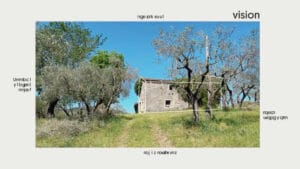
The Anatomy of Renovation Costs: What Does It Really Cost to Restore a Country House in Southern Lazio?
Read More »THINKING OF BUYING OR RENOVATING A HOME IN ITALY?
Get practical insights on property checks, renovation costs, local regulations and life in Southern Lazio — delivered to your inbox.
No spam. Just useful advice and inspiration. Unsubscribe anytime.